
Blog post #14, 30 January 2024
Much has been written about Hamas’ dreadful October 7th attack and Israel’s brutal war of retaliation. This post places this debate in perspective by looking at the history of terrorism in Palestine-Israel and elsewhere. This history teaches us two things. First, terrorism is part of political conflicts between those in power and those challenging them. State terrorism and non-state terrorism occur in reaction to one another, producing cycles of violence. Acts of terrorism are justified by referring to the violence of the opponent, whether physical or structural, in the form of state repression. Second, state actors usually try to obfuscate this interactive and political character of terrorism. They do this by claiming that only non-state actors can use terrorism, by framing their own violence as a justified response, and by painting their non-state opponents as crazed, fanatical, inhuman, barbaric, and evil – in other words, as apolitical. However, obscuring the ‘violent dialogue’ of which terrorism is a part prevents the full analysis needed to find a solution.
Though there is much debate about how to define terrorism, there is agreement that it is a form of violence that falls outside of the laws of war, either because it takes place outside war zones, or because non-combatants are targeted, or both. The aims of terrorism are political or political-ideological. Terrorism aims to generate attention, fear, or unrest to influence public opinion or political decision making. It can be directed at specific targets, such as political leaders, or random targets, such as commuters on a train or visitors to a café. However, the victims of terrorist violence are not its eventual targets, as the violence is intended as a message to a wider public and/or its leaders. This ‘communicative’ or ‘performative’ aspect is important in understanding terrorism: nineteenth-century anarchical terrorists called it ‘propaganda of the deed’. Others have referred to terrorism as a ‘violent form of communication’ which is part of a ‘violent dialogue’ between state and non-state actors.
While state actors often use terrorist means to scare adversaries – or citizens – into submission, in the case of non-state terrorists it has been called a ‘weapon of the weak’. Groups that do not have the means, or the support base, to challenge their state opponents through nonviolent action or rebellion can get a lot of attention through terrorism. By spreading fear they hope to pressure governments into concessions. Another part of their strategy is often to provoke their adversary into a harsh response in order to weaken the reputation of the state, polarize public opinion and win support for extremism. In that, they have often been successful. The War on Terror that followed Al Qaeda’s 9/11 attacks of 2001 and that claimed hundreds of thousands of casualties is an example. It appears that Hamas had similar aims when it planned the 10/7 attack in 2023: banking on a violent Israeli response, it hoped that this would outrage world opinion and undercut the agreements Israel was negotiating with Arab states. Of course, this cynical strategy shows Hamas’ utter disregard not only for Israeli lives, but Palestinian ones as well.
As far as we know, the term terrorism was first used in 1795 by Edmund Burke who wrote about “thousands of those hell hounds called terrorists” who were let loose on the people (Laqueur, 2017(1977), p. 34). Burke used the term to describe state violence, namely, that of the Jacobins in revolutionary France. A few years into the French Revolution, this radical group had taken the lead. To protect the revolution from opponents, they introduced a reign of terror, which they themselves proudly called La Terreur. In this period, which lasted from 1792-1794, thousands of people ended up under the guillotine. The aim was not only to kill ‘reactionaries’, but also to sow fear among the population to prevent resistance.
The practice of terrorism, even if it was not called it at the time, is much older. Since the advent of powerful empires and states, they have used violence to terrorize civilians. Conquerors often set harsh examples by exterminating entire populations or by forcing the conquered into exile. Ancient empires showed little mercy to those who did not submit willingly to their rule. The Romans are but one example. They brutally suppressed Spartacus’s followers, destroyed Carthage, and did the same to the Dacian nation (present-day Romania). Captured Dacians were enslaved, and many became gladiators. Julius Caesar claimed to have exterminated 430,000 members of Germanic tribes.
Meanwhile, non-state terrorism was used by those who wanted to challenge the powers that be, but lacked the means to stage an all-out rebellion. Terrorism offered them the chance of high impact through limited means by yielding fear and attention. The first known non-state terrorists were the sicarii, a radical Jewish sect that was part of the Zealot movement resisting the Roman occupation of Palestine in AD 66-73. The sicarii were named after their favourite weapon, a small, curved dagger named a sica, which they hid under their coats. Their victims were Jewish moderates whom they saw as collaborating with the Romans, both in Palestine and among the diaspora in Egypt. The sicarii attacked their enemies by daylight in crowded places, often on holy days, mingling with the crowd so that it was often impossible to know who had carried out the attack. They set fire to the homes and palaces of power holders, including a high priest and several kings. The sicarii are also said to have burned granaries and sabotaged Jerusalem’s water supplies. Their political desire to free Palestine from the Romans was mixed with religious ideas; they believed that God would reveal Himself to them once Palestine had been freed. Like some terrorists of our time, they also regarded martyrdom as joyful.
Let us stay in Palestine, but fast forward to 1917, when, in response to the growing Zionist movement that wanted a national home for Jewish people in Palestine, British Foreign Secretary James Balfour issued a statement expressing British support for this aim. Increasing numbers of Jews, often persecuted in their countries of residence, began to migrate to Palestine. However, the British had made similar promises to the Palestinian Arabs residing in the area. When in 1922 they were given a mandate by the League of Nations to administer Palestine, the British therefore found themselves with impossible dual obligation. Against this background, violent Zionist organizations began a terrorist campaign aimed at the departure of the British and the establishment of a Jewish state. Groups such as Irgun, Lehi, and the Stern gang attacked British targets and Arab civilians. Soon, the Palestinian al-Qassam group began committing anti-British violence as well, in some cases also targeting Jews and fellow Arabs. But it were the Zionist extremist groups that would have the biggest impact on subsequent events. In 1944 they assassinated British administrator Lord Moyne and in 1948 UN envoy Folke Bernadotte. In 1946, disguised as Arab workmen and hotel waiters, Irgun operatives smuggled explosives hidden in milk cans into the King David hotel in Jerusalem, causing an explosion that killed 91 people and injured 45. The attacks increased the pressure for British withdrawal, which commenced in 1947.
A British and UN plan to divide Palestine into an Arab and a Jewish state was rejected, and war broke out between Jews and Palestinians, followed by war between Israel and surrounding Arab states. At the Deir Yassin massacre, Irgun and Lehi killed over a hundred Palestinian Arab villagers. Palestinian militants responded with an attack on a Jewish convoy that was on its way to a hospital. Deir Yassin terrorized the Palestinian population: after the massacre, they feared the advancing Jewish and (after May 1948) Israeli forces so much that many of them fled their homes, never to return. Later, the Israeli army would call Deir Yassin a “decisive accelerating factor” in the Palestinian exodus known as Nakba (Norman, 2021, p. 406). When the state of Israel was founded, the Irgun and Lehi were absorbed into the Israeli army. Irgun leader Menachem Begin would later become Prime Minister.
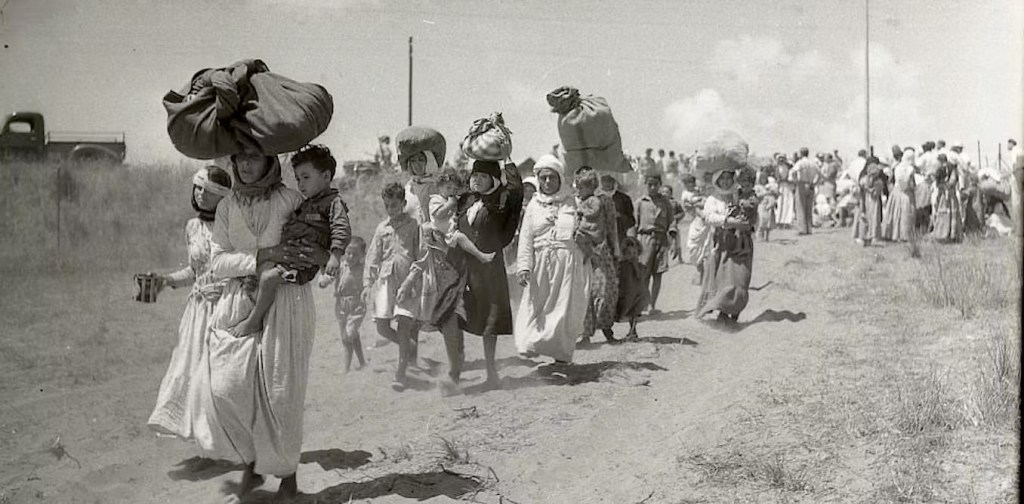
After the establishment of Israel on May 14th1948, it were the Palestinians who resisted what they saw as the occupation of their country. The 1950s saw the founding of the left-wing Popular Front for the Liberation of Palestine (PFLP), the Democratic Front for the Liberation of Palestine (DFLP), and the Palestine National Liberation Movement (Fatah). In 1964, they would merge into the Palestinian Liberation Organization (PLO), but conflicts between the factions would continue, contributing to violence as groups sought to outdo each other. Meanwhile, other fringe groups and breakaway individuals carried out even more brutal attacks.
The Israeli occupation of the West Bank after the 1967 war gave a new impetus to terrorism on both sides. Israel engaged in raids of Palestinian villages, collective punishment, home demolitions and curfews imposed in villages with suspected militant links, and preventive arrests of opposition leaders. In the first two decades of the occupation of the West Bank, approximately 500,000 Palestinians, or one in three, were arrested. On their part, Palestinian groups hijacked no less than sixteen airplanes between 1968 and 1976 and undertook various other international attacks, sometimes in cooperation with extreme-left groups from Germany and elsewhere. In 1972, during the Munich Olympics, eleven Israeli athletes and officials were taken hostage by a Fatah faction called Black September. All hostages, a German police officer and five hostage takers were killed. The Munich attack took place just acter Israel had assassinated Ghassan Khanafani, a prominent Palestinian writer and editor of PFLP’s magazine, in retaliation for an attack on Lod Airport. Israel responded to Munich by commencing the targeted assassinations of militants, which it has continued since.
From 1974 onwards, PLO/Fatah chose the path of diplomacy and peace talks. This led to a pushback from other Palestinian groups both within and outside the PLO, who continued to carry out attacks. On the side of Israel, radicals also violently opposed the peace process. A group called the Jewish Underground was founded in 1979 in response to the 1978 peace accord between Israel and Egypt. The group bombed Palestinian mayors, used violence against civilians, and carried out an attack on a college campus. Israel labeled the group as terrorist and arrested some of its members.
In 1982, the Israel Defense Forces (IDF) invaded southern Lebanon, following a series of attacks and counterattacks between on the one hand the PLO and a rival organization led by Abu Nidal, both operating in southern Lebanon, and the IDF under Prime Minister Begin on the other. With the backing of the IDF, led by later Israel Prime Minister Ariel Sharon, a Christian Lebanese militia committed a massacre in the Palestinian refugee camps of Sabra and Shatila. Israel would occupy southern Lebanon until 2000. In the mid-1980s the first Palestinian intifada began with mass protests, strikes, and civil disobedience against Israeli occupation and the lack of rights for Palestinians. Violence was also used, mostly youth throwing stones and Molotov cocktails at Israeli soldiers. The first direct peace negotiations also commenced in this period, leading to the 1993 Oslo Accords. However, the agreement was rejected by extremists on both sides. In 1994 Jewish extremist Baruch Goldstein opened fire in a mosque in Hebron, killing 29 worshippers and wounding 125. The next year, another Jewish extremist killed Israeli PM Rabin for ‘selling out’ at Oslo. In response to Hebron, a new hardline organization called Hamas carried out its first suicide attack on Israeli citizens.
The events between Oslo and the present day are well known: the creation of the Palestinian Authority (PA) to govern parts of the West Bank, the limited autonomy and ineffective governance of the PA, ongoing colonization of the West Bank by growing numbers of Israeli settlers, suicide attacks on Israeli civilians by Hamas and other extremist groups and the fear this engendered, increasing violence against Palestinians by settlers, the Second Palestinian Intifada, which was grimmer than the first, the forced destruction of Palestinian homes, Israel’s withdrawal from the Gaza strip, Hamas’ rise to power there, the regular launching of rocket attacks by Hamas on Israel, the Gaza wars, 7 October…
This short history of terrorism in Palestine illustrates that terrorism takes place within a context of political conflict. However, this interactive nature of terrorism is muddled by an ongoing battle of words. Except during La Terreur, states have rarely, if ever, used the word ‘terrorism’ to describe their own actions, preferring to apply the label to the non-state actors that challenged them. Similarly, except for the violent anarchists of the late 19th and early 20th century, who wore ‘terrorism’ as a badge of honour, non-state actors have avoided labelling their violence in this way, preferring to call themselves freedom fighters, soldiers, or rebels. Terrorism is thus mostly a term applied to others. It serves to deny the legitimacy of ‘their’ violence while affirming the necessity of ‘ours’.
Governments take pains to describe the ‘terrorist’ violence of their opponents as extreme, crazed, and unprovoked, whilst justifying their own ‘civilized’ violence as a benign and necessary response to its threat. In this way, “the state seeks to claim and police a distinction between its own violence and that of others” (Thorup, 2010, pp. 27-28). Take, for example, the interpretation put forward by Benjamin Netanyahu. In 1984, Netanyahu, then Israeli Ambassador to the US, wrote:
“The root cause of terrorism lies not in grievances but in a disposition toward unbridled violence. This can be traced to a world view which asserts that certain ideological and religious goals justify, indeed demand, the shedding of all moral inhibitions. In this context, the observation that the root cause of terrorism is terrorists is more than a tautology.” (Cited in (Said, 1986)
On 30 October 2023, in an op-ed in the Wall Street Journal titled ‘The Battle of Civilization’, Netanyahu, now Prime Minister of Israel, wrote:
“The horrors that Hamas perpetrated on Oct. 7 remind us that we won’t realize the promise of a better future unless we, the civilized world, are willing to fight the barbarians. The barbarians are willing to fight us, and their goal is clear: Shatter that promising future, destroy all that we cherish, and usher in a world of fear and darkness. (…). In fighting Hamas and the Iranian axis of terror, Israel is fighting the enemies of civilization itself. Victory over these enemies begins with moral clarity. It begins with knowing the difference between good and evil, between right and wrong. (..) Today we draw a line between civilization and barbarism. It is a time for everyone to decide where they stand.” (Netanyahu, 2023)
After 9/11, 2001, this line of thinking became particularly dominant as analysts and politicians described terrorism as religiously motivated, fanatical, irrational, and out to destroy the Western way of life. That jihadi terrorists themselves referred to politics to explain their actions – talking about Western violence in the Muslim world, oppression by Arab dictators, Israeli occupation of the West Bank, and policies discriminating against Muslims in Western countries – did not receive much attention, even though the selection of the targets on 9/11 itself – the Pentagon and World Trade Centre as symbols of American military and economic domination – might have given a hint.
Governments preferred to shy away from these inconvenient aspects by portraying non-state terrorism as crazy and bloodthirsty. Dehumanizing language also fits in this pattern, as Israeli officials used when calling Hamas ‘human animals’. This, too, fits in a long tradition. To give but one example, the Irish Republican Army (IRA), which used terrorism in its quest to unite Ulster with the rest of Ireland, were referred to as ‘bloodthirsty monsters’ and ‘dogs who had to die’. (Carr, 2011, p. 9). Such depictions, as when the Nazis called Jews ‘rats’ and the Rwandan Hutu genocidaires called Tutsis ‘cockroaches’, serve to morally disengage from the enemy, justifying harsh violence against them.
This narrative on terrorism silences debate about what may cause it. Indeed, governments have often described non-state terrorism as a moral evil so destructive and dangerous “that even to suggest that it might have context, causes and aims that could be rationally understood was sometimes viewed as a form of moral collusion.” (Carr, 2011, p. xvi) To refer to the political context of terrorism is often seen as controversial; trying to understand its causes is equated with justifying it. However, it is possible to both thoroughly disapprove of terrorist violence and try to understand its context and causes. How else can we find a way to peace?
Sources:
Bandura, A. (2015). Moral Disengagement: How People Do Harm and Live with Themselves . Worth, IL: Worth Publishers.
Bhatia, M. V. (2005). Fighting Words: Naming Terrorists, Bandits, Rebels and Other Violent Actors. Third World Quarterly, 26(1), 5-22.
Bilotta, J. (1989). Thatcher calls bombers ‘monsters’. UPI archives(https://www.upi.com/Archives/1989/09/25/Thatcher-calls-bombers-monsters/4622290700906/).
Carr, M. (2011). The Infernal Machine: An Alternative History of Terrorism. London: Hurst .
Erlenbusch-Anderson, V. (2018). Genealogies of Terrorism: Revolution, State Violence, Empire. New York: Columbia University Press (e-book).
Galtung, J. (1969). Violence, Peace, and Peace Research. Journal of Peace Research, 6(3), 167-191.
Gat, A. (2006). War in Human Civilization. Oxford: Oxford University Press.
Kundnani, A. (2014). The Muslims Are Coming!:Islamophobia, Extremism, and the Domestic War on Terror. London: Verso.
Laqueur, W. (2017(1977)). A History of Terrorism. London and New York: Routledge ebook.
Martin, G. (2021). Understanding terrorism: challenges, perspectives, and issues. Thousand Oaks, California: SAGE ebook.
Netanyahu, B. (2023, October 30). The Battle of Civilization. The Wall Street Journal .
Norman, J. M. (2021). Terrorism in Israel/Palestine. In R. English, The Cambridge History of Terrorism. Cambridge: Cambridge University Press ebook.
Reid, R. (2021). Terrorism in African History. In R. English, The Cambridge History of Terrorism. Cambridge: Cambridge University Press ebook.
Richardson, A. (2004, December 9). Pact stalls over call for proof that IRA disarming. The Globe and Mail(https://www.theglobeandmail.com/news/world/pact-stalls-over-call-for-proof-that-ira-disarming/article1008442/).
Said, E. (1986). The Essential Terrorist. The Nation, https://www.thenation.com/article/archive/essential-terrorist/.
Slim, H. (2007). Killing Civilians: Method, Madness and Morality in War. London: Hurst & Company.
Thorup, M. (2010). An Intellectual History of Terror: War, violence and the state. London and New York: Routledge.

 War and Peace Blog
Geef een reactie op Hamas and Israel, part II: Violence as a strategic error – War and Peace Blog Reactie annuleren